

Trump video
Audio of the man-child Hunter talking about his partner in business
BREAKING: New audio of Hunter Biden talking about his partner “the f**king spy chief of China”
“I’m receiving calls from SDNY” @TheNatPulse https://t.co/vDYnxNTvo6
— Jack Poso 🇺🇸 (@JackPosobiec) October 27, 2020
American media refusing to investigate this story indicates just how bad, how biased, how unprofessional the media is.
Never Trumper cognitive dissonance. Do these people forget what they previously wrote? How do you explain this?
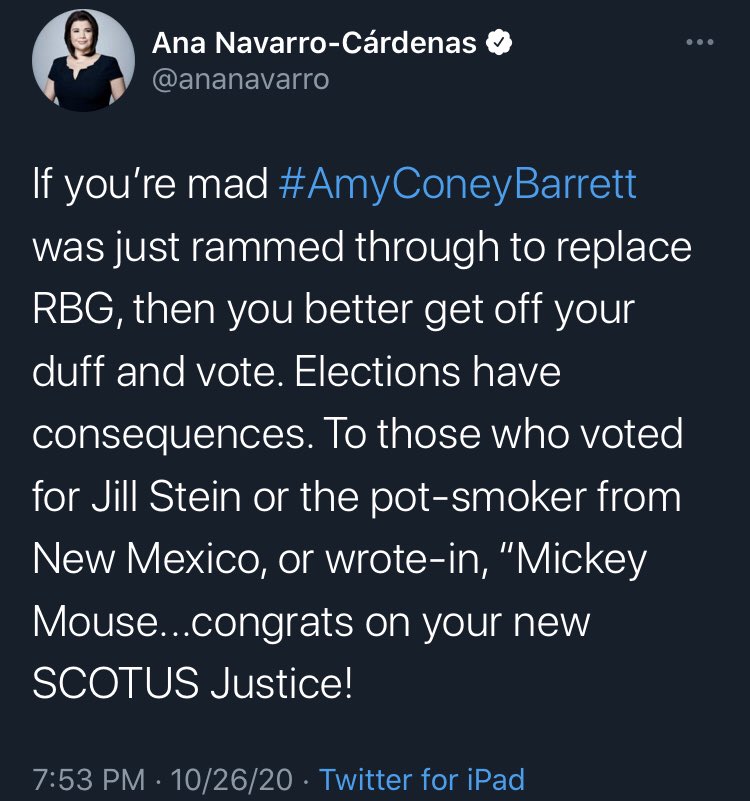
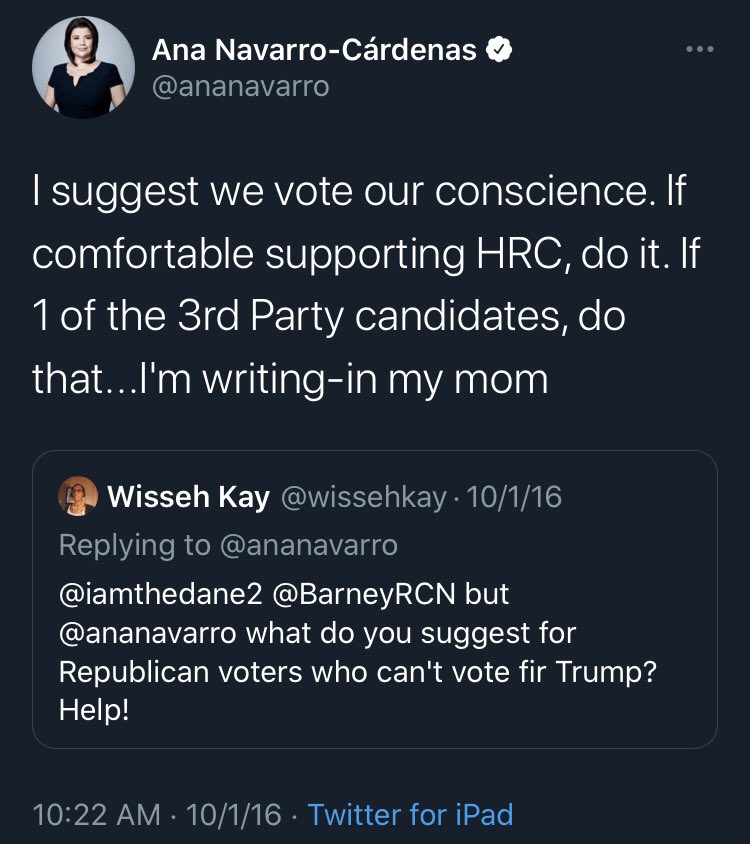
Trump’s great power is to cause otherwise normal people to self-destruct.
Consequences


Birthday wishes
— Jon Gabriel (@exjon) October 27, 2020
Mollie eats Jake’s lunch
No offense, but literally no GOP consultant with even a modicum of political savvy or common sense would suggest a Supreme Court Justice not attend her own swearing in at the White House. So if this anonymous person exists, you can stop relying on him for GOP perspective. https://t.co/TLwK99hCca
— Mollie (@MZHemingway) October 27, 2020
The end game of Democrat policies
Motorcyclist Who Identifies As Bicyclist Sets Cycling World Record https://t.co/vsQu6QZVMB
— The Babylon Bee (@TheBabylonBee) October 26, 2020
The current state of the Democrat party
These people are literally psychotic. Totally melting down over ACB’s confirmation. pic.twitter.com/yQuQ1VnFLF
— Ian McKelvey (@ian_mckelvey) October 27, 2020
Mental illness as social theater.
Democrat.
Who are the candidates again?
Biden: 'I Am The Only Candidate Who Can Beat Ronald Reagan'https://t.co/rDFiQbl1wO
— The Babylon Bee (@TheBabylonBee) October 26, 2020
Georgia Democrat candidate for U.S. Senate thinks voters are stupid and he can dupe them, watch.
BREAKING: Senate candidate @ossoff keeps progressive values 'low key' to sway Georgia "rednecks"
"On the surface portrays himself as left or moderate…deep down he's a low key progressive"
"Genuine to a certain point…but he can't show true self 100% of the time"#Expose2020 pic.twitter.com/Bso7lki3KJ
— James O'Keefe (@JamesOKeefeIII) October 26, 2020
Project Veritas Journalist: Do you think Georgians are stupid enough?
Nguyen: Yeah. You can spread that to your other progressive friends but keep this on low key. On the surface, he tries to portray himself as left of moderate, so that all Georgians, not us Georgians, but all the rednecks and all that stuff will be like, “Oh he’s kind of cool. But he’s not so far left that I’m not cool with that.” But deep down he’s low-key progressive so it’s something that keeps you pumped up. Especially because I know he’s going to win.
Democrat.
This is who they are.
Vote Democrat and this is what you will get.
Senator Ron Johnson: Biden is lying
Sen. Ron Johnson: Biden ‘Lying’ About His Son Not Making Money in China
“…Sen. Ron Johnson (R-Wis.), chair of the Senate Homeland Security and Government Oversight Committee, said on Sunday that former Vice President Joe Biden was “lying” when he said last Thursday that his son did not get money from China.
At his final debate with President Trump, Biden said, “My son has not made money in terms of this thing about, what are you talking about, China. I have not had a — the only guy who made money from China is this guy. He’s the only one. Nobody else has made money from China.”
“Well, the vice president is lying again,” Sen. Ron Johnson told “Sunday Morning Futures” with Maria Bartiromo…”
CNN makes a straight news report
Pennsylvania voters tell CNN they back President @realDonaldTrump over Joe Biden: “they will not survive if fracking does not exist” pic.twitter.com/mFo6hPv8C9
— Steve Guest (@SteveGuest) October 26, 2020
Messages

He’s getting worse, can the media carry him across the finish line?
🚨🚨🚨🚨🚨🚨
The GREATEST #SleepyJoeBiden SPEECH
absolutely NO ONE understood.(Like most of his statements)#DementiaJoe #JoeBidenIsSick #TrumpLandslide2020 pic.twitter.com/44Tkw89F96
— TMK (@FascistTwatter) October 27, 2020
Tony Bobulinski on Tucker Carlson tomorrow. Sounds like a big show.
Tony Bobulinski will play recordings of Biden operatives begging him to stay quiet on Tucker Carlson tomorrow.
Joe Biden is absolutely done – and if you voted for him, some states allow you to change your vote!
— Ryan Fournier (@RyanAFournier) October 26, 2020
Buzz Aldrin Endorses Arizona Sen. McSally Over Former Astronaut Mark Kelly
SCOTT MOREFIELD:
“…Legendary astronaut Buzz Aldrin expressed his support for Republican Arizona Sen. Martha McSally’s bid to keep her seat over her Democratic challenger in a Friday evening tweet.
McSally, a former United States Air Force pilot and congresswoman who was appointed by Arizona Gov. Doug Ducey to fill the seat of the late Republican Arizona Sen. John McCain, has been running significantly behind former astronaut Mark Kelly throughout the 2020 Senate race. However, recent polls have shown the Arizona senator closing the gap of late, and one even has her leading by two percentage points, according to Real Clear Politics.
Aldrin used fighter pilot lingo in his tweets to praise McSally for moving “ahead past Mark, to 12 o’clock” and potentially delivering a “win for Arizona!”…”

Neil took this picture of Buzz during their initial inspection of the Lunar Module following trans lunar injection, July 16, 1969.
Bernie Goldberg on the state of American media
American Journalism 2020: R.I.P.
“…As a personal favor, I ask you to please not laugh out loud when I say: Let’s take journalists at their word when they tell us the only reason they’re not running the Hunter Biden story is that, because they’re unbiased, honest, trustworthy professionals, they don’t want to traffic in an unsubstantiated smear campaigns.”
Okay, you can laugh your heads off now.
Let’s be generous and say that at the outset they had reasonable concerns. How could they know if the emails were real? The story might be Russian disinformation. Rudy Giuliani, the president’s lawyer and pal, is involved — that’s a reason to be skeptical. The story broke in the New York Post, a tabloid owned by the conservative tycoon Rupert Murdoch. Fox News, another Murdoch property, ran with the story. How could they even know the computer in question belonged to Hunter Biden? Isn’t the computer repairman almost blind? And what a coincidence, they say, that all of this comes out just days before the presidential election!
It’s not their reasoning, dishonest as it is, that’s so annoying. It’s the sanctimony of these journalists that’s galling. They’re not running the story because they don’t want to be participants in a smear campaign that might affect a presidential election – and they want us to really believe that?
Let’s make sure we understand that these are the same people who ran story after story about a fake dossier that was packed with lies about Donald Trump.
They’re the same people who ran countless stories informing us that Donald Trump was a Russian asset.
These are the same noble journalists who gave Adam Schiff more airtime than their own anchors get – all because he said he had solid proof that Donald Trump colluded with the Russians.
Where was their concern for authenticity and their aversion to smear campaigns back then? Do they think reasonable people don’t notice how hypocritical – and corrupt – they are?
So if the story about Hunter Biden and his father Joe were about Donald Trump and his son or daughter, are we supposed to think that these journalists would show the same restraint they’re now showing?
Do they think anyone who’s been paying attention would actually believe that?
We all know why they’re censoring news about the Biden family even after the Director of National Intelligence told us that there was no Russian disinformation campaign involved; even after Fox News obtained a receipt from the computer repair shop with Hunter Biden’s signature on it, indicating that the computer is indeed his; even after Hunter Biden’s ex-business associate said the emails were authentic and accused Joe Biden of lying about his involvement in his son’s business.
Here’s what that ex-business partner, Tony Bobulinski, said 90 minutes before the presidential debate in Nashville last week, something else most journalists played down or flat out ignored:
“I have heard Joe Biden say he has never discussed his dealings with Hunter. That is false. I have firsthand knowledge about this because I directly dealt with the Biden family, including Joe Biden.”
At the debate, Joe had every opportunity to say Bobulinski wasn’t telling the truth. He didn’t. He had every opportunity to say, without equivocation, that the emails were fabrications. He didn’t.
Journalists used to be curious. They wanted to find out what was true. That was before Donald Trump became president and they embarked on what they see as a noble mission — to get him out of office and put Joe Biden in the White House. They think they’re doing America a great big favor by abandoning traditional principles of journalism and replacing them with partisan support for the candidate they want to win.
It’s true that we don’t know if Joe actually received money to peddle his influence to the Chinese and others. At the debate, he said, “I have not taken a penny from any foreign source in my life.” That may be true. But did he get foreign money indirectly, through his son?
Here’s Kimberly Strassel in the Wall Street Journal:
“The former vice president is running on trust and good judgment. The Hunter tale is at best the story of a wayward son and indulgent father. At worst, it is an example of the entire Biden clan cashing in on its name with a U.S. rival. As Mr. Biden refuses to answer questions about this case, voters will have to make up their own minds. But given Hunter’s exploits in China, Ukraine, Kazakhstan and elsewhere, much more is yet to come—in the next week and a half and potentially in a Biden presidency.”
***
A final word about what has gone way beyond bias in American journalism, especially in places like the New York Times, a place where so many other journalists take their cues.
Every morning the Times runs an online feature called “Morning.”
On the morning after the debate, the headline said: “Good morning. Biden and Trump meet in their final debate, and we break it down for you.”
Here’s how the Times broke it down:
“But the debate wasn’t normal by the standards of nearly all of American history. It wasn’t normal because one of the nominees — the sitting president — told one lie after another.”
But what about Joe Biden? Was he always telling the truth? The Times relied on a CNN fact checker to tell us that, “Biden was again imperfect from a fact check perspective. He made at least a few false, misleading, or lacking-in-context claims. Trump was, as usual, a serial liar.”
There’s still a week to go before Election Day so anything can happen. But we do know this much right now: Journalism is the big loser in 2020. Journalists have squandered what little credibility they still had left. And they may be the only ones who don’t know it.
Or simply don’t care…”
Americans have common sense
Most voters believe Joe Biden knew about Hunter’s overseas deals: poll
“…Most American voters believe Democratic nominee Joe Biden was involved in his son Hunter’s controversial business dealings, a new poll has found in the wake of The Post’s exclusive reporting on the family’s murky overseas ties.
The survey of 1,000 likely voters by Rasmussen Reports found 54 percent believe it’s “likely that Biden was consulted about and perhaps profited from Hunter’s overseas business deals.”
Forty-four percent consider it “very likely” while 38 percent said it was unlikely Biden was involved in his son’s affairs overseas, including 21 percent who said it was “not at all likely.”
A tranche of documents reported by The Post earlier this month revealed how Hunter Biden sought to leverage access to his then-vice president father to make millions of dollars overseas.
One email also indicated that the oft-troubled son also introduced the elder Biden to a Ukrainian energy executive a year before he lobbied officials in Ukraine to fire a prosecutor who was investigating the company…”
Navajo Nation endorses Trump